
Tens of Millions in Funding: Harnets.AI Rebuilds AIDC Network Infrastructure and Wins Over RMB 100 Million in Orders in Three Months
Harnets.AI, Zhipu AI, and Tsinghua University introduced the ZCube architecture, reducing cluster network-hardware cost by one-third and increasing GPU inference throughput by 15%.
Editor | Zhang Yuxin (张雨忻)
In One Sentence
A Tsinghua-affiliated startup challenging conventional network architecture, Harnets.AI worked with Zhipu AI and Tsinghua University to introduce ZCube, a new architecture that can increase token output in inference clusters by 15% while cutting network-hardware cost by about 33%.
Funding
Harnets.AI recently completed a financing round of tens of millions of RMB, exclusively led by Zhipu AI; Yuanhe Capital serves as its long-term financial adviser.
Products and Business
Since the start of the year, agent applications such as Claude Code have entered deployment, driving sustained growth in token consumption and compute demand.
Harnets.AI CEO Xiong Dian told us that some chips have long been in a supply shortage, while prices for switches—the core networking hardware of clusters—have nearly doubled since the start of the year.
Against this backdrop, the network is becoming a key variable determining AI-compute-cluster performance. Harnets.AI has introduced ZCube as a new networking technology at the architectural level.
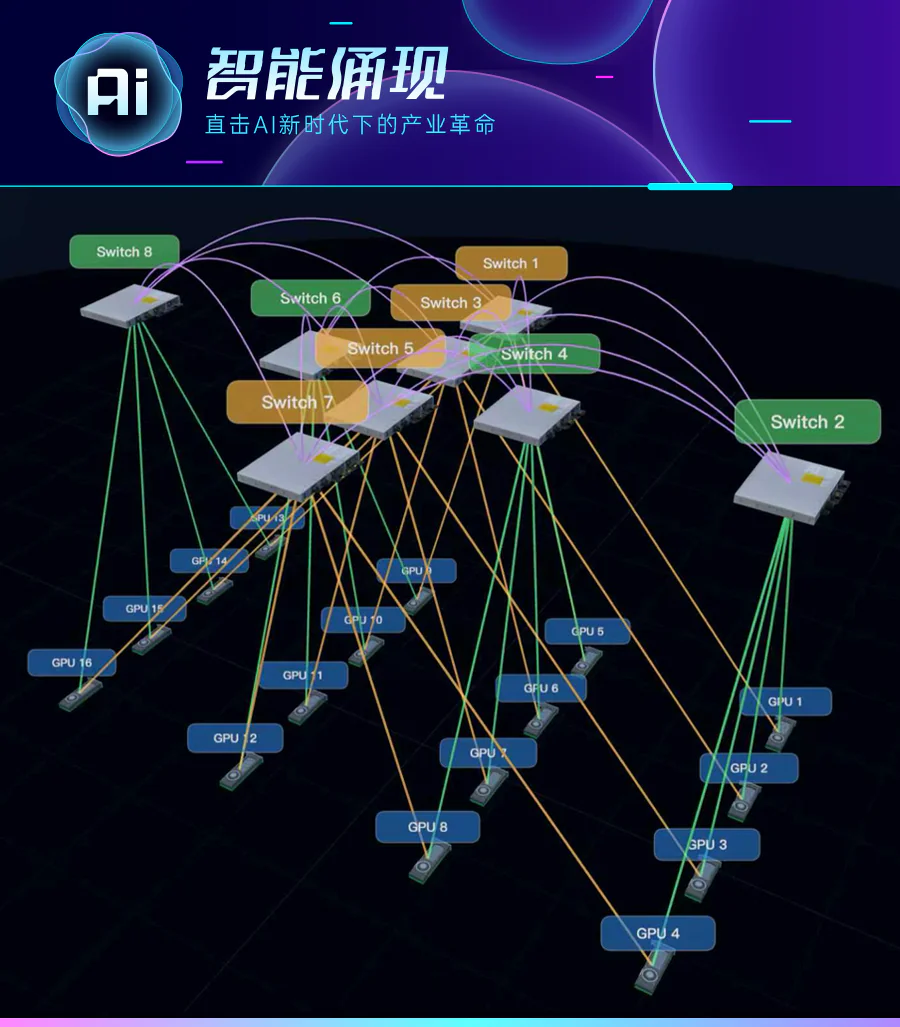
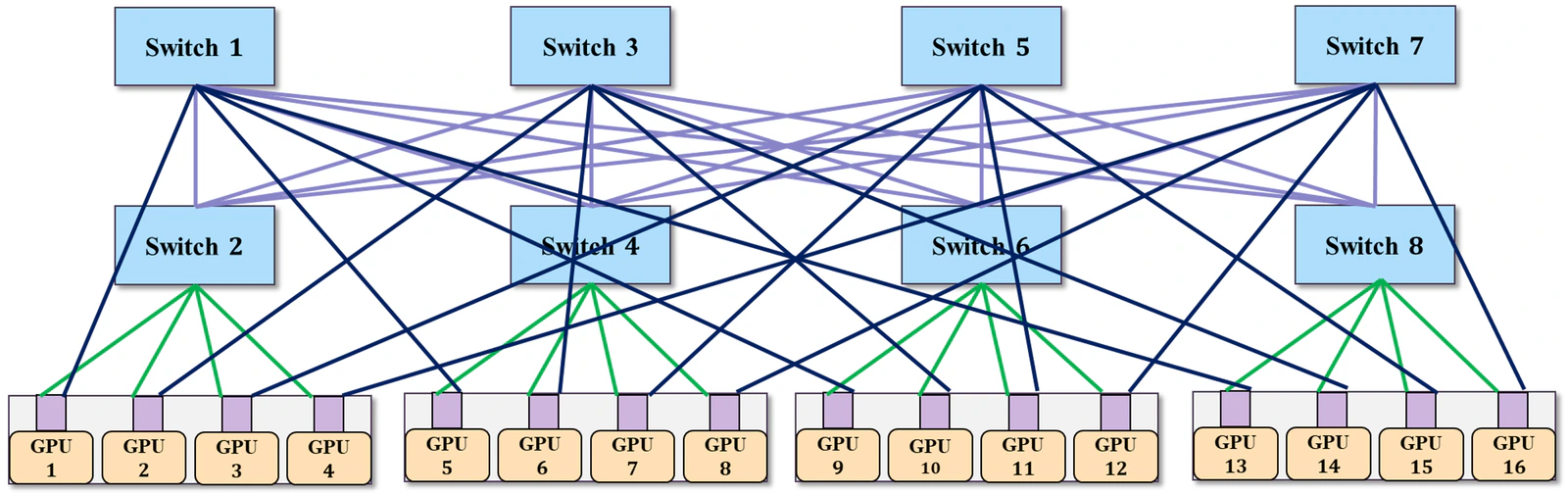
ZCube is a networking architecture that connects GPUs and switches in a new way. Its core idea is to discard the multi-tier tree structure of traditional networks in favor of a fully flat interconnect.
The architecture was validated in a Zhipu AI compute cluster. Results from a 1,000-GPU production cluster for GLM-5.1 Coding inference show that, with GPUs and the software stack unchanged, a network-architecture upgrade alone raised throughput by 15%, reduced latency by 40.6%, and cut switch and optical-transceiver cost by 33.3%.
On throughput alone, a ZCube cluster can directly increase token output by 15%, potentially adding tens of millions of RMB in revenue for an enterprise.
According to Zhipu AI's public blog, at the same scale ZCube saves about one-third of hardware cost versus conventional architecture. In a 10,000-GPU AI cluster, this can save about RMB 210 million to 640 million in network-hardware investment.
Around ZCube, Harnets.AI also provides YCOS tuning services and XOPS operations solutions.
Although existing compute clusters differ in scale and condition, this does not prevent Harnets.AI's business from scaling.
On one hand, the industry has strong demand to build new compute clusters from the ground up.
On the other hand, although Harnets.AI delivers projects individually, ZCube technology itself is highly standardized. Switch and server configurations can be replicated from one 1,000-GPU cluster to another.
Xiong Dian said ZCube project delivery is measured in weeks and takes no more than two months. Each project needs only one on-site project manager, allowing a 20-person team to support orders worth more than RMB 100 million.
To date, Harnets.AI has served customers including Zhipu AI and Infinigence, with orders on hand exceeding RMB 100 million.
Core Moat
A paper on ZCube was formally published in August 2025.
In May 2026, ZCube was first validated in Zhipu AI's 1,000-GPU NVIDIA cluster, then proved effective in a series of domestic-GPU clusters such as Moore Threads. In June, ZCube and its industry applications received the WAIC 2026 SAIL TOP30 award.
Compared with conventional network architecture, ZCube addresses the following issues:
1. It replaces the former single-mode multi-rail or single-rail access with a hybrid of both.
Some switches connect same-index cards in different servers in a single-rail pattern, while others tightly connect consecutively indexed GPUs in a multi-rail pattern.
This shortens GPU-to-GPU paths. Each GPU connects to switches, and communication crosses only two switch hops, substantially reducing latency versus the three or more hops required by conventional architecture.
2. It effectively breaks traditional architecture's performance bottlenecks.
In conventional Clos and ROFT fabrics, random multipath selection often creates hash collisions that limit network utilization. ZCube's flat topology and deterministic paths substantially reduce collision probability at the architectural level, improving bandwidth use and effective throughput.
3. By reducing switches by one-third, it also reduces optical transceivers and fiber by one-third, lowering network cost, reducing failure sources, and limiting the impact of individual faults.
At the same time, more deterministic network paths provide natural physical isolation of multi-tenant traffic, making clusters more stable under parallel workloads.
The Team
Harnets.AI was founded in March 2026. Its approximately 20-person team primarily comes from Tsinghua University.
Founder and CEO Xiong Dian is a PhD candidate in Tsinghua University's Department of Computer Science. He previously spent nearly four years interning in ByteDance's infrastructure organization and was among its first employees to work on large-model training.
Co-founder Wang Han leads market-related work and has 20 years of executive experience at leading ICT (information and communications technology) companies, including as an executive in an AIDC division at a networking company.
Co-founder Yan Zihan is also a PhD candidate in Tsinghua University's Department of Computer Science and the first author of the paper on ZCube architecture.
Founder Perspective
Over the past few years, the industry has moved from compute oversupply to an explosion of demand.
In 2023, the industry rapidly built a wave of clusters. By 2024, major model providers were still in pretraining and compute capacity was redundant, so the infrastructure market had lower expectations for AI.
By early this year, the explosion of agents drove token demand to a new peak. Zhipu AI faced the same issue: existing clusters had insufficient performance and there were not enough of them.
From services to end-to-end solutions; from labor-intensive work to a larger market.
Our team previously focused on network tuning, simulation, and operations—labor-intensive work that was fundamentally service-oriented. Harnets.AI has expanded into software, hardware, and services because:
first, end-to-end solutions can scale further than services alone while better ensuring delivery efficiency and outcomes;
second, large models are the future. Traditional IDC clusters can last more than a decade, while today's AIDC clusters generally last three to five years, ensuring continuing demand for network construction.
The current focus is inference.
Inference-side compute demand is now exploding. Hash collisions in traditional architectures often create unpredictable latency fluctuations, which are particularly damaging for inference. This is precisely where ZCube has an advantage.
Harnets.AI's real moat lies in engineering capability.
Simply interconnecting a network according to a topology diagram does not make ZCube ready to use. It is not a point technology; behind it is a complete, complex engineering deployment, including switch and server configuration, routing-table design, and more.
ZCube has hardware requirements, but the threshold is falling.
ZCube requires every GPU to access two network ports—either through a dual-port NIC or equivalent access to two independent NICs. Some domestic GPUs do not yet meet this requirement.
In the long term, the threshold for domestic GPUs to use ZCube is steadily falling: their compute performance is improving, NIC configurations are catching up, and dual-port NICs are becoming more widespread, providing better fault tolerance and networking flexibility.