
WAIC 2026 | Visit Harnets.AI at the WAIC Ecosystem Exhibition

WAIC 2026
Intelligent Partners, Creating the Future Together
Harnets.AI invites you to the 2026 World Artificial Intelligence Conference

Forum Invitation
On the morning of July 19, Harnets.AI Chairman Xiong Dian (熊典) will present the ZCube architecture at the “Next-Generation AI Computing Cloud Industry Technology Innovation Forum.”

Harnets.AI
Shanghai Yuxun Network Technology Co., Ltd., operating as Harnets.AI, created the ZCube AI-cluster networking architecture to reduce cost and improve efficiency in AI-network infrastructure. With a core portfolio including ZCube switches, the ZCube Controller, ZCube networking-service toolchains, the YCOS AI-network tuning system, and the XOPS AI-network operations system, it provides full-lifecycle AI-network services. Harnets.AI advances compute infrastructure toward higher efficiency, lower cost, greater determinism, and higher stability, while working with ecosystem partners to build the next-generation AI-network foundation and maximize the value of every GPU.
ZCube AI-Cluster Networking Architecture
The ecosystem exhibition presents Harnets.AI's original ZCube AI-cluster networking architecture, including the following key technologies.
1. ZCube interconnect structure. It uses a fully flat networking design, with GPU servers accessing the network through a hybrid of single-rail and multi-rail mechanisms.
2. ZCube routing system. It uses two-hop flat routing between GPUs across the fabric to eliminate congestion caused by traffic collisions and contention at the root.
3. ZCube deployment toolchain. Independently developed tools for ZCube network-cabling correctness diagnostics and automated configuration substantially shorten deployment time.
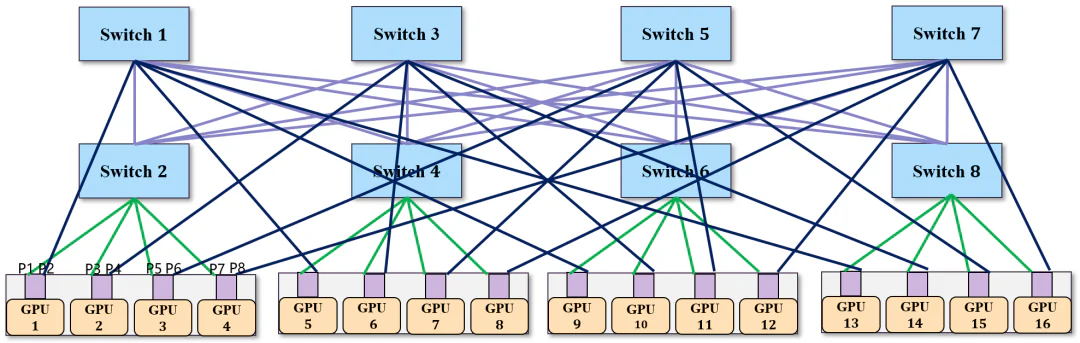
As a next-generation flat AI-cluster networking architecture that disrupts conventional designs, ZCube has six structural advantages: lower networking cost, fewer failure sources, shorter GPU-to-GPU paths, stronger load balancing, smaller failure domains, and better multi-tenant isolation. It has now been deployed and is running reliably across multiple GPU types and 1,000-GPU-scale clusters.