
Harnets.AI: Next-Generation AI Network Infrastructure for Maximum Token Production Efficiency

As large-model inference grows rapidly, next-generation AI clusters are pursuing maximum effective compute and compute cost efficiency. Effective compute is the performance computing equipment actually delivers under real workloads; compute cost efficiency is effective compute per unit cost. Yet the Clos architecture, proposed in 1953 and widely used for AI clusters today, struggles to meet those demands. To address this core issue, Harnets.AI introduced ZCube, a new AI-cluster networking architecture for next-generation AI network infrastructure with maximum token production efficiency.
ZCube Networking Architecture
Clos scales networks by stacking multiple switch layers. Its limited load-balancing capability, however, constrains bandwidth performance in the high-bandwidth conditions of AI inference. At large scale, its many switches and optical transceivers also raise network cost, failure sources, and stability risk.
ZCube is Harnets.AI's original flat-networking architecture, designed specifically for AI clusters and built without a multi-tier tree. Its principle is “use flatness for efficiency and determinism for performance.” It reconstructs the physical underlay with lower hardware cost, shorter paths, and more deterministic forwarding to achieve ideal fabric-wide switch load balancing, increase cluster throughput, and fully release compute performance. The related paper was published at SIGCOMM 2025 and was described by the review committee as significantly changing how networks are thought about and understood.
Key ZCube Technologies
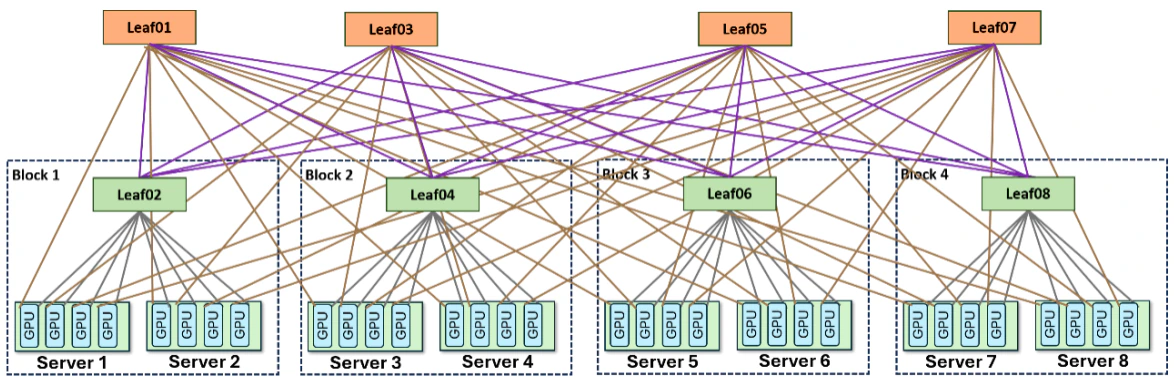
As Figure 1 shows, key ZCube technologies include:
1. Removing Spine-layer switches;
2. Dividing Leaf switches into two equal groups—odd and even by index—and interconnecting the groups as a complete bipartite graph;
3. Connecting each GPU NIC's two ports to the corresponding switches in the two groups through single-rail and multi-rail access, respectively.
ZCube's Structural Technical Advantages
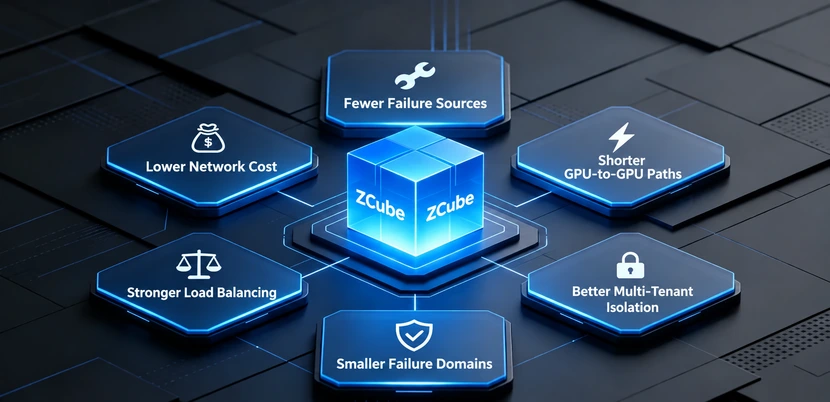
Compared with Clos architectures such as Fat-Tree and Rail-Optimized Fat-Tree, ZCube has six structural technical advantages:
1. Lower network cost: at the same compute scale, it requires two-thirds as many switches and optical transceivers as Clos.
2. Fewer failure sources: removing Spine equipment simplifies forwarding nodes, reducing architectural failure sources and improving cluster stability.
3. Shorter paths between GPUs: communication between any GPU nodes crosses only two forwarding hops rather than Clos's three to five, reducing GPU-to-GPU latency.
4. Stronger load balancing: structural global load balancing avoids common Clos problems such as ECMP hash polarization and uneven link load through topology design.
5. Smaller failure domains: without failure propagation from Spine switches, a single-device fault affects only local nodes rather than causing fabric-wide performance fluctuation.
6. Better multi-tenant isolation: link-level fine-grained traffic isolation helps avoid congestion interference and security risk in multi-user environments.
ZCube Deployment Examples
1. Zhipu AI 1,000-GPU Inference Cluster
In May 2026, Harnets.AI helped Zhipu AI deploy ZCube in a 1,000-GPU production cluster running GLM-5.1 inference services. Production performance showed that, compared with ROFT, ZCube increased GPU inference throughput by more than 15% and reduced P99 time to first token by more than 40%.
2. Shanghai Yidian 1,000-GPU Domestic-GPU Cluster
In June 2026, Harnets.AI helped Shanghai Yidian (上海仪电) validate a ZCube deployment on a 1,000-GPU domestic-GPU cluster. Across inference services in eight scenarios, average time to first token (TTFT) fell by 22%–30% and GPU inference throughput increased by 7%–10%.
Full-Lifecycle AI-Network Services Based on ZCube
With its core portfolio of ZCube switches, the ZCube Controller, ZCube networking-service toolchains, the YCOS AI-network tuning system, and the XOPS AI-network operations system, Harnets.AI provides full-lifecycle AI-network services. It advances compute infrastructure toward higher efficiency, lower cost, greater determinism, and higher stability, while continuing to open technical capabilities and industry collaboration with ecosystem partners to build the next-generation AI-network foundation and maximize the value of every GPU.